The Third Stomach
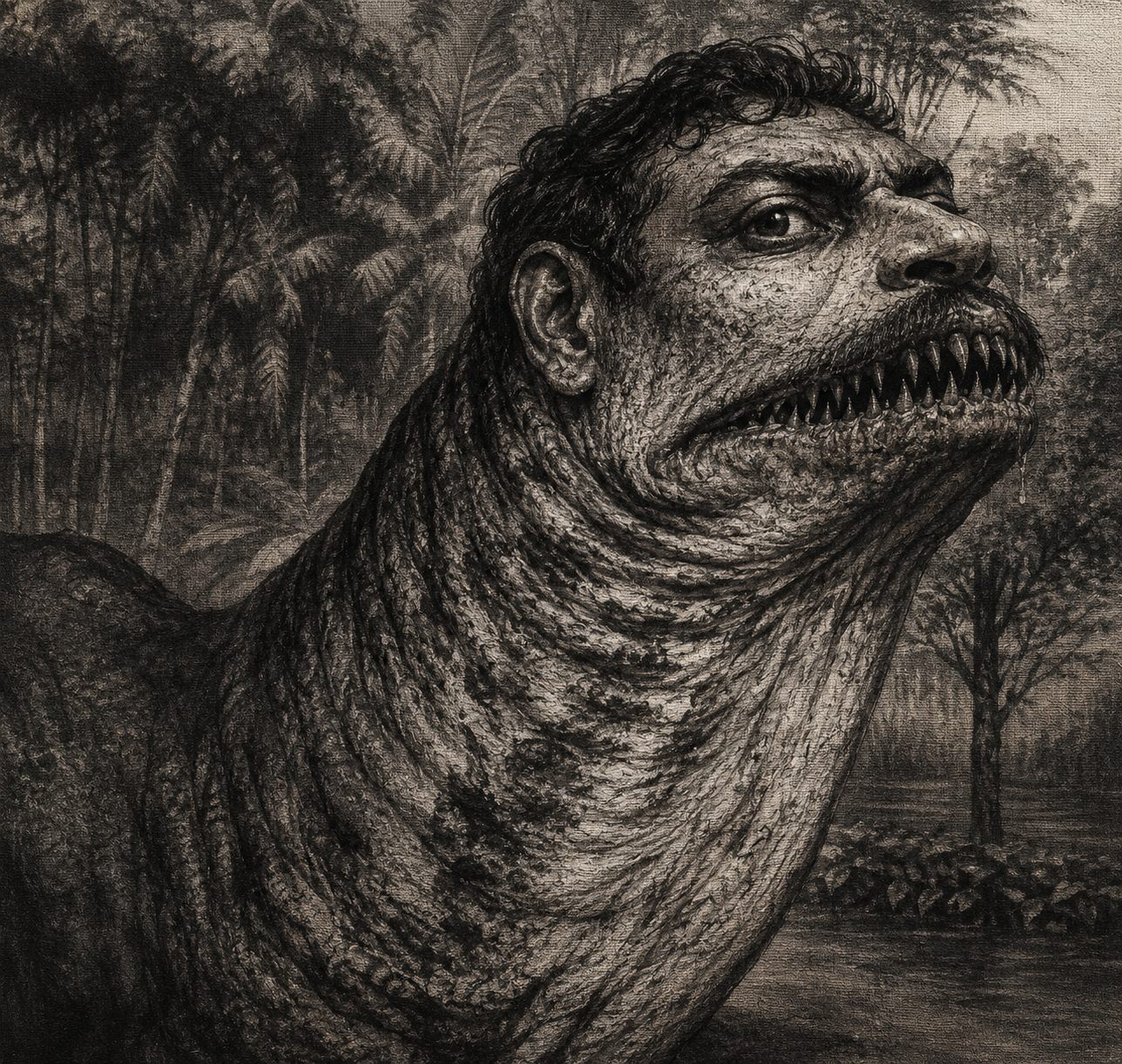
THIS IS A WORK OF FICTION
By eight in the morning, the cow had blocked the tramline.
Not metaphorically blocked, as in Bengali conversation, where any inconvenience becomes a siege of Troy. Truly blocked. She stood crosswise before the rusted rails near the old temple lane off Chitpur Road, her hide the color of wet jute, her ribs showing with the sad arithmetic of city cattle. A tram bell clanged. A taxi honked. Two scooters found, in that mystical Calcutta way, an inch and a half of passage where no inch and a half existed.
“Ei, Ma, move a little,” said Nirmal, pushing at her flank with both hands.
The cow looked back with one large black eye, chewed something silver, and declined.
Rain from the night before still lay in the broken road, mixing with crushed marigold, betel spit, engine oil, and the pale wash of milk poured over the Shiva lingam at dawn. Above the lane, political posters peeled from walls like old skin. Below them, a tea stall was already doing business with the grave confidence of a national institution. Someone’s radio played Rabindrasangeet under static. Someone else shouted about the price of fish. A priest’s conch blew from inside the temple, thin and wet, like a seashell with asthma.
Nirmal tried again. The cow’s tail slapped his cheek.
“Fine,” he said. “You also have union rights.”
The tea stall laughed. The tram driver did not.
Nirmal was fifty-two, a caretaker of a temple that had never officially hired him and never officially paid him enough to leave. He swept the courtyard, lit lamps, collected flowers rotting at the goddess’s feet, scolded boys for scratching names into the plaster, and kept account of donations in a red notebook whose pages smelled of incense and damp cupboard. He had once been a clerk in a printing press, before the press became a boutique café with exposed brick and English sadness on the menu.
Now he lived in the room behind the temple storeroom, with a tin trunk, a mosquito net, two shirts, and a photograph of his younger brother Subhash, who had died three years ago under the back wheel of a lorry carrying cement for a luxury housing complex. Subhash had been drunk. The driver had run. The cow in the road that night had not moved either.
So Nirmal did not like cows.
This was inconvenient in his line of work.
Inside the temple courtyard, Bhola Baba was preparing to become famous.
He sat beneath the banyan, cross-legged on a frayed tiger-print mat, though everyone knew the tiger had been polyester. He wore saffron robes too clean for holiness and had a beard that forked majestically, as if two goats had argued on his chin. Before him lay a brass plate, a heap of fresh cow dung arranged like a dark green hill, and a ring of men with phones held high.
“Do not record from wrong angle,” said Haradhan, the temple committee secretary. “Take portrait also. For poster.”
“It is not for poster,” said Bhola Baba, eyes shut.
“Of course, Baba. Only for spreading devotion.”
There it was, Nirmal thought, the new religion of the city: devotion, but with distribution strategy.
A woman in a synthetic red sari pressed closer. “Baba will eat?”
“He will purify,” Haradhan said.
A boy giggled. His mother pinched him into respectability.
Nirmal stood near the bell rope with his broom. He had been told to sweep only after the miracle. Miracles, in his experience, produced litter.
Bhola Baba opened his eyes. They were ordinary eyes, faintly yellowed, slightly afraid. For one second he looked at Nirmal, and something passed between them—not blessing, not command. Embarrassment.
Then he took a pinch of dung and put it in his mouth.
The courtyard gasped.
The cow at the gate lowed.
Bhola Baba chewed slowly, visibly, theatrically. A greenish smear clung to his beard. Cameras moved closer. Haradhan whispered, “Again, Baba. Little more.”
Baba swallowed.
Nirmal felt his own stomach twist. Faith was one thing. This was another. Calcutta had always had room for eccentric holiness: men sleeping on nails, women walking barefoot to Kalighat, accountants fasting on Tuesdays while cheating on Wednesdays. But there was a difference between devotion and performance. One fed the soul. The other fed committee accounts.
Baba reached for another pinch.
The bell began ringing by itself.
Not much. Just once. A soft bronze tremor.
Everyone turned.
The bell hung still.
“Wind,” said Haradhan quickly.
There was no wind. The morning was wet and breathless. Even the incense smoke rose straight and tired.
Baba’s hand paused over the plate. His eyes had gone wide.
Then he smiled, because cameras are a kind of police.
By noon, the clip had traveled through Burrabazar, Shyambazar, WhatsApp aunties, paan shops, and one local news van that arrived with a reporter whose hair had been constructed rather than combed. The temple lane filled. Men who had not visited their parents in months came to ask blessings for business. Women brought children. A politician’s assistant brought garlands and calculation.
Nirmal swept marigold sludge toward the drain and watched Haradhan place a donation box beside Baba’s mat.
“Committee decision,” Haradhan said.
“There was no meeting.”
“You were sweeping. That is also a form of meeting.”
Baba sat under the banyan, sweating. Every hour he took another ceremonial pinch, smaller each time. People shouted “Gomata ki jai!” A goat tethered near the sweets shop screamed with secular panic.
At four, Nirmal carried tea to Baba.
The holy man’s fingers trembled around the clay cup.
“Enough now,” Nirmal said quietly.
Baba looked toward Haradhan, who was showing the reporter where to stand.
“They paid advance,” Baba whispered.
“For eating filth?”
“For my daughter’s hostel fee.”
Nirmal stopped. It was always like this. Scratch miracle, find school admission. Scratch holiness, find rent. The poor did not become saints first. They became desperate, and someone else named it.
“You are not a Baba?”
“I was a kirtan singer in Krishnanagar.” He coughed. His breath smelled sour, grassy. “Voice gone. Wife gone. Daughter studying nursing in Siliguri. Haradhan said three days only. Then people will forget.”
“People do not forget filth,” Nirmal said. “They make it permanent.”
Baba gave a weak smile. “You are very philosophical for a man with broom.”
“A broom shows truth. Everything comes down.”
The bell rang again.
This time twice.
No one pulled the rope.
Baba’s smile broke.
That night, after the crowd thinned and Haradhan locked the donation box in the inner office, Nirmal found hoofprints in the courtyard.
They were too large.
Not cow-large. Something else. Each print was deep in the wet clay near the banyan, cloven but stretched, longer than his hand, the edges sharp as if pressed by an iron tool. They led from Baba’s mat to the old sanctum wall and stopped there.
Nirmal crouched, touched one print, and smelled his fingers.
Not dung.
Old earth. River mud. A smell from before drains, before petrol, before the city decided to improve itself into suffocation.
From behind the wall came a sound.
Chewing.
The sanctum wall was older than the temple itself, or so the old priest used to say before dying with surprising neatness during afternoon nap. Behind it lay a sealed chamber. British-era records called it a grain room. Local gossip called it a tunnel. Haradhan called it “heritage asset” whenever some developer came sniffing.
Nirmal pressed his ear to the plaster.
Something inside exhaled.
Warm air touched his cheek through a crack.
“Mice,” he told himself.
The crack widened.
Not visibly. Not dramatically. But a flake of lime fell and landed on his foot.
He stepped back.
In his room, sleep would not come. Rain began again, ticking on tin, dripping through some ancient failure in the roof. He dreamed of Subhash lying in the road, his mouth open, one hand still clutching a packet of sweets he had bought for Nirmal. In the dream, Nirmal did not run to him. He stood beside a cow and waited for it to move.
When he woke, his pillow smelled of grass.
The second day was worse.
Baba’s face had changed.
At first Nirmal thought it was swelling from sickness. The jaw looked heavier. The cheekbones broader. His eyes sat farther apart, or seemed to. When Baba spoke, his voice came low and thick, the words dragged through some new chamber in his throat.
“Water,” he said.
Nirmal brought it.
Baba drank three brass lotas without stopping.
“Stop the show,” Nirmal whispered.
Haradhan appeared behind him. “What show? This is faith.”
“This is a man becoming ill.”
“Faith often looks like illness to unbelievers.”
“Money often looks like faith to committee people.”
Haradhan’s smile tightened. He wore white kurta, gold chain, sandalwood paste on his forehead, and the offended dignity of a man who had discovered that morality was bad for revenue.
“Careful, Nirmal. You sleep here because we allow it.”
“God allows it.”
“God does not sign property papers.”
By afternoon, Bhola Baba’s fingernails had blackened and thickened. He kept his hands tucked into his robes. The crowd chanted. The bell rang at irregular intervals. Each time, the cow at the gate bellowed and tried to pull free from the boy who now charged five rupees to touch her.
A little girl dropped a guava near Baba’s mat. He lunged.
Not reached. Lunged.
His mouth opened too wide. The guava vanished with a wet crunch. The girl began crying.
“Blessing!” shouted Haradhan.
People cheered.
Nirmal saw Baba’s tongue. It was dark, rough, and long.
That evening, Sefali came to the temple.
She was Subhash’s widow, though nobody in the family said widow anymore; it made relatives uncomfortable, like unpaid loans. She sold incense sticks near Sovabazar and visited Nirmal once a month to collect what small money he could spare for her son, Bappa. She had a narrow face, quick eyes, and a way of standing that made pity retreat.
“You are making circus now?” she said, watching people push toward the banyan.
“I am not making anything.”
“You never make. You watch. Then later you feel bad.”
It landed because it was true.
Nirmal took out two hundred rupees.
She did not take it. “Bappa needs tuition money. Science teacher says without coaching he will fall behind.”
“Everyone falls behind now,” Nirmal said. “Only coaching centers move ahead.”
She looked at Baba. “That one is eating cow dung?”
“For education also, apparently.”
“Then Calcutta is finished. Earlier we sold land for children. Now we sell stomach.”
The bell rang again. Three times.
Sefali frowned. “Who is pulling?”
“No one.”
From the sanctum wall came a crack like a knuckle breaking.
The crowd heard. For once, silence fell.
A bulge appeared in the plaster behind the goddess, low and round. The framed calendar beside it slipped down and shattered.
Haradhan ran forward. “Old wall, old wall. Nothing. Please move back. Baba will give special blessing.”
Baba rose.
The courtyard inhaled.
He had grown. There was no polite way around it. His robes came short at the ankles. His shoulders strained the cloth. The beard had fallen away in patches, revealing skin beneath that was not skin exactly but thick hide, gray-brown and pebbled. Two hard knobs pushed against his forehead.
He looked at Nirmal.
Help me, his eyes said.
His mouth said, “More.”
Haradhan, pale now but still loyal to income, lifted the brass plate.
Baba slapped it away.
Dung scattered across the courtyard. People shrieked. The cow broke her rope and stumbled backward into the lane. The temple bell swung violently, though the rope hung untouched.
Then the wall behind the goddess split open.
A smell came out: wet hay, old bones, buried river, and something enormous digesting time.
From the crack emerged a horn.
It was not like the gentle crescent horn of a street cow. It was black, ridged, and long as a man’s arm. Then came another. Between them pushed a skull too broad for the opening, cracking brick, showering lime dust over the goddess’s face. The idol tilted. Someone screamed that this was a sign. Someone else screamed that this was not the preferred type of sign.
Nirmal grabbed Sefali’s arm. “Go.”
“My bag—”
“Leave it.”
The thing in the wall snorted.
Baba fell to his knees, clawing at his throat. His robe split down the back. Beneath it, his spine rose in knobs. A tail, thick and muscular, unfurled from him with a sound like wet rope.
The crowd broke.
Calcutta crowds do not run all at once. First they argue with reality. Then they test alternative exits. Then, when reality proves stubborn, they become a single many-legged creature. Sandals flew. Children wailed. The reporter kept filming until her cameraman abandoned her, which proved there are limits to journalism.
Nirmal pushed Sefali toward the side gate.
Behind them, Baba roared.
It shook dust from the rafters.
Not a tiger roar. Not a cow bellow. A deep, wooden, prehistoric blast, as if a conch had been blown inside the belly of the earth.
Nirmal turned.
Baba was still partly human in the face, and that was the worst of it. His eyes remained frightened, ashamed, apologetic. But his body had become massive, hunched, four-legged, with a hide like cracked temple stone. Horns tore from his skull. His jaws lengthened. Flat grinding teeth showed behind lips that pulled back in misery. Along his spine rose a row of bony plates, small at the neck, taller toward the shoulders, absurd and terrible, like some Jurassic beast God had designed after hearing only a rough description of a cow.
The thing from the wall answered him.
It was larger.
Only its head and forequarters had emerged, but already the sanctum lay ruined. It had the same impossible mixture: cow and dinosaur, sacred poster and fossil nightmare. Around its neck hung old bells green with age. Its eyes were blind white.
Haradhan stood frozen beside the donation box.
The ancient creature lowered its head and sniffed him.
Haradhan whispered, “Ma?”
It opened its mouth.
Nirmal did not watch.
He dragged Sefali through the side gate into the lane. Rain hammered down. People scattered past tea stalls and shuttered shops. The cow that had blocked the tramline ran madly in circles, plastic bags tangled around her horns. The tram driver had abandoned his tram and was climbing through a sweet shop window with impressive agility for a man of his build.
Sefali pulled free. “Bappa!”
“He is at home.”
“He came here after tuition. For the video. He said all boys are coming.”
Nirmal’s stomach dropped.
“No.”
She grabbed his shirt. “Find him.”
Inside the temple, something crashed. The banyan shook. The bell rang and rang.
Nirmal could have run. Many sensible men were doing exactly that. He could have said the lane was blocked, the temple gone, the boy lost in the crowd. He could have preserved the small, shabby remainder of his life.
But Subhash lay in the rain inside him, still waiting for Nirmal to move.
He went back.
The courtyard had become a churned swamp of flowers, dung, broken brick, and abandoned shoes. The transformed Baba staggered near the banyan, smashing donation bowls under enormous hooves. The ancient cow-beast was still forcing itself through the wall, widening the gap with each heave. Its blind eyes rolled. Its bells clanked without rhythm.
“Bappa!” Nirmal shouted.
A small voice answered from the storeroom.
The door had jammed behind a fallen beam. Nirmal ran to it, slipping once, cutting his palm on glass. Through the crack he saw Bappa, twelve years old, thin as a question mark, clutching Nirmal’s red account notebook.
“Mama!”
“Move back.”
“I can’t. There is something behind the sacks.”
Nirmal looked past him.
In the dark of the storeroom, two pale calves stood where no calves had been. Their legs were too long, their heads too bony, and their wet mouths worked softly. Around them lay torn sacks of old offerings, hay, and paper.
They were eating the temple records.
Nirmal slammed his shoulder into the door. Once. Twice. Pain burst through him. The beam shifted.
Behind him, Baba lowed.
Nirmal turned.
The creature that had been Bhola Baba stared at him with human eyes from a beast’s head.
Help me.
Then Baba charged the ancient thing.
Not at Nirmal. Not at the crowd. At the beast from the wall.
Their horns met with a sound like a tram collision. The courtyard stones cracked. Baba shoved, muscles trembling, holding the ancient cow back from the storeroom. The blind creature shrieked and swung its head, smashing him into the banyan. He rose again.
Nirmal understood then.
The dung had not transformed him by itself. It had called what was buried. Or woken it. Or fed it a shape. Baba had become the door, but also the lock. Human shame wrapped around old hunger. A poor man’s performance had given a fossil god a stomach.
Nirmal hit the door again. The beam fell. Bappa burst out, sobbing.
“Run to your mother,” Nirmal said.
The boy hesitated.
“Run, you donkey prince!”
Bappa ran.
One of the pale calves followed.
Nirmal seized the bell rope and swung it sideways. The rope caught around the calf’s neck. It kicked, light and strong, its hooves striking sparks from stone. Nirmal pulled with everything he had. The bell rang overhead, deafening. The calf bucked, snapped the rope, and fell into the old offering pit near the banyan.
The pit.
Nirmal stared.
Every morning for years he had emptied flowers, ash, spoiled milk, coconuts, and sacred leftovers there before municipal pickup. But below the pit was the old drainage channel, bricked over, leading under the sanctum wall.
Leading into whatever chamber had held the ancient beast.
Ordinary clues assembled with cruel patience: the smell from the crack, the hoofprints stopping at the wall, the cow refusing the tramline, the temple records with older pages missing from one corner, chewed to lace. The beast had been feeding for years on offerings. Milk, flowers, belief, decay. Baba’s act had only given it meat.
Nirmal ran to the office, where Haradhan had kept the keys. Haradhan’s sandals remained. Haradhan did not.
The storeroom key hung from the nail. So did the kerosene lamp key, useless in daylight, ridiculous in apocalypse. Nirmal took the kerosene can instead.
At the pit, the fallen calf was chewing.
It looked up with a child’s cloudy eyes.
“No,” Nirmal said, to it, to himself, to whatever gods were doing clerical delay in heaven.
He poured kerosene into the pit.
The ancient beast sensed it. Its blind head swung toward him.
Baba, bleeding dark from the mouth, pushed once more. His hooves slid in mud. His human eyes fixed on Nirmal.
Now.
Nirmal struck a match.
Rain killed it.
He struck another. His fingers slipped.
The ancient beast broke free and drove one horn through Baba’s shoulder. Baba made a sound almost like speech. Not mantra. Not prayer.
“My daughter,” he seemed to say.
Nirmal shielded the match under his shirt and struck the third.
It caught.
He dropped it.
The pit bloomed fire.
Blue first, then orange. The calf screamed. Flame raced down into the drainage channel with a hungry whoosh. Under the temple, something vast ignited—not exploded, exactly, but awakened in reverse. Heat lifted the courtyard. The ancient beast reared, its bells clanging madly. Cracks raced across its hide, glowing from within like a kiln.
Baba turned his ruined head toward Nirmal.
For one moment he was a man again only in the eyes.
Then he drove himself forward, pushing the ancient beast back into the burning wall.
The chamber swallowed them.
The sanctum collapsed.
Morning’s goddess, evening’s monster, committee office, donation box, heritage asset, miracle mat, all went down in brick, smoke, bells, and a smell like burned hay after a thousand-year monsoon.
Afterward, people said many things.
That gas cylinders had exploded. That extremists had attacked. That the temple committee had violated building rules. That the holy Baba had ascended bodily and would reappear in a superior locality. That Haradhan had gone to his sister’s house for his nerves. That the video was fake. That the video was proof. That in ancient times everything was possible, but now no one had proper faith.
The city digested the event as it digested everything: with tea, argument, and mild constipation.
The temple was sealed by afternoon. Police tape sagged in the rain. Reporters came. Officials came. Men in helmets came and made notes nobody would read. Sefali took Bappa home and, for the first time in years, touched Nirmal’s feet before leaving. He hated it. He let her.
At dusk, Nirmal sat on the tramline.
The cow had returned.
She stood where she had stood that morning, chewing quietly, the torn plastic gone from her horns. Her black eye watched him.
“I know,” Nirmal said. “You tried to stop it.”
The cow flicked an ear.
From the ruins came a small sound.
Not a crash. Not a bell.
Chewing.
Nirmal stood.
In the wet ash near the collapsed sanctum, half-buried under brick and marigold paste, lay his red account notebook. Its cover was burned. He picked it up and opened it.
Most pages were gone.
Only the oldest remained, stuck together with damp. On the inside back cover, in handwriting not his own, not Haradhan’s, not any priest’s he knew, someone had written a list of names. Dates beside them. Offerings beside the dates. Milk. Hay. Grain. One name every few decades, then closer together as the city grew hungrier.
At the bottom was Bhola Baba’s real name.
Below it, in fresh wet letters that had not been there before, was Nirmal’s.
The cow behind him lowered her head.
Not in threat. In invitation.
The temple ruins breathed out warm grass-scented air.
Nirmal looked down the tramline toward the traffic, the tea stall, the city pretending to resume. Somewhere Sefali was scolding Bappa. Somewhere a girl in Siliguri would soon learn her father had become a miracle, then a rumor, then nothing useful at all.
The ash shifted.
A small pale calf pushed its head out from under the bricks and began, patiently, to chew the edge of his shoe.